The Index: Week 16/6 - 22/6
Get up to date on this week in the markets!

Welcome to this weeks Index.
Podcasts included:
ProfG Markets
The Joseph Carlson Show
The Compound
My Wall St
Animal Spirits
The All-In podcast
Podcast one: ProfG Markets (Posted daily Monday 16/6 to Friday 20/6)
Google offers to buyout employees across the company in an effort to reduce headcount
They’re offering 14 weeks pay for those choosing to leave
Also tightening ‘return-to-office’ policy for those living within 50 miles of an office
Is this a pre-cursor to mass layoffs at Google? Potentially in the search division?
Scott made the point that the people taking these buyouts are usually your best employees - they have other options
AI is increasingly being used for ‘efficiency surveillance’ - informs management about who contributes most to the company (a positive development for the 'quietly productive’ worker not on managements radar)
Last week, a Boeing 787-8 crashed in India, killing over 200 people
First ever crash in this new model of Boeing aircraft - it crashed into a building shortly after take-off (cause is yet to be determined)
Boeing stock fell 8% in pre-market trading
Boeing has double the amount of crashes as Airbus - still 1 crash in 184 million flights (Airplane is still safest form of transport)
The chances of dying on a commercial plane crash are 1 in 11 million
The chances of dying my lawnmower accident are 1 in 12 million
The chances of dying by choking on food are 1 in 2,500
Boeing execs are now in crisis-management mode - typically a company will: acknowledge the issue, take responsibility for it, the over-correct to restore confidence
Is this a buying opportunity for Boeing? Still a duopoly market between Boeing and Airbus. Most people don’t know and don’t care what type of aircraft they’re getting on. The stock was up 20% YTD prior to this crash
Blackstone announced plans to invest $500 Billion in Europe over the next decade
Called the region a ‘major opportunity for growth’
$100 Billion will be invested in the UK
The move will make Blackstone the largest real-estate fund manager in the EU
Yale university endowment is looking to sell Billions in Private Equity investments
The fund has already sold $3 Billion at a slight discount
On average, Private Equity investments returned 7% last year vs S&P returns of 25% (even over a 10-year time frame - this trend stays the same)
Scott describes the ‘Alternative Investment Industrial Complex’ - rich people like to believe that they’re special and can outperform the market so they pay huge fees to fund managers that inevitably underperform a basic market index
ProfG Markets: Tuesday episode (17/6)
Oil prices rose as middle-east tensions spiked over the weekend between Israel and Iran
Initial attacks sent oil prices up 7% on Friday last week (Brent Crude hit $74 per barrel - lower than 2024 average, still higher than one month ago)
WSJ reported that Iran wants to de-escalate the conflict - prices dropped 2%
Oil price provides some context for the situation - When the Russia-Ukraine conflict started, oil prices rose consistently for months. So far the market is not too worried about the conflict escalating and/or spreading
Iran can still participate in the global oil economy - no international export centres have been targeted by Israel
There is a risk that Iran will move to close the Strait of Hormuz - 20 million barrels of oil/oil products pass through here daily. This low probability/high consequence event is being priced into Crude oil futures
People are buying ‘tail-hedge’ options to protect against this happening - price of these options has increased (market now prices it happening at 10-12% vs 1% before this conflict began)
Iran has a tendency to use this as an empty threat during times of conflict
Meta announced that WhatsApp will be getting ads
Ads will be displayed in the ‘updates’ tab - separate from personal conversations (Meta stock climbed 2.5%)
Facebook acquired WhatsApp for $19 Billion (WhatsApp’s whole appeal was that it would never run ads)
WhatsApp has 3 billion active monthly users globally as of March 2025 - this moved should generate around $4 billion in ad revenue for Meta
Should not be a surprise - everything in the digital economy will eventually be subsidised by ads
Crypto company Tron has announced it will go public later this year by merging with SRM entertainment
SRM stock rose 647% on the news ($155 million market cap)
In 2023, Tron and its founder Justin Sun were charged by the SEC over allegations of selling unregistered securities and market manipulation. The case was dropped as soon as Trump entered office
Last month, Sun attended Trumps Crypto banquet (he was one of the top 24 holders of Trumps meme coin)
Sun also invested $75 million into WLF (World Liberty Financial)
The investment bank that brokered the deal, Dominari securities, has head-quarters on the 23rd floor of Trump Tower, 2 floors below the offices of the Trump organisation
Advisors on Dominari’s board - Eric Trump and Don. Jr
They have knowingly decided to run this listing on the public market because any private investor would call BS on this company. They assume the public market investors will buy in
ProfG Markets: Wednesday episode (18/6)
Open-AI and Microsoft Feud
Partnership started back in 2019 (Microsoft gave them $1 Billion)
The disagreement started with Open-AI’s acquisition of Windsurf (AI code generation company - MSFT competitor)
Under the terms of their contract with Microsoft, Open-AI must grant them access to all of Windsurfs Intellectual property
Microsoft owns the rights to all of Open-AI’s IP (they can just copy and paste it to fit their business)
Microsoft is the exclusive ‘compute partner’ for Open-AI - if they need more compute power to train their AI models, they need to source it through Microsoft
The companies have a ‘revenue sharing agreement’ where 20% of Open-AI’s top-line revenue goes to Microsoft
ProfG Markets: Thursday episode (19/6)
Coinbase stock jumped 16% as the senate passed the stable-coin bill (Genius Act)
Uber and Lyft shares both fell after Waymo announced plans to apply for an NYC testing permit
Nippon Steel has officially closed its $14 Billion takeover of US Steel
Biden came out against the deal citing national security risks
US government now has a ‘golden share’ in the company - they effectively have control of the business
Gives the president the right to make decisions related to the following: capital investment, company name changes, HQ relocation, acquisitions and closing factories
This is an unusual move - in the past the government has only taken a stake in a company if there’s a severe threat to the economy (AIG in 2008). In this case, US steel is the 23rd largest steel producer globally, so no significant threat exists. Chipotle employs 7x more people than US steel
Has Trump set a precedent with this decision? Will other foreign investors or companies looking to merge with a US company be reluctant to do so? Why would they give up this level of control to a foreign government?
Podcast two: The Joseph Carlson Show (Posted Monday 16/6)
Jeff Bezos was once asked about what’s going to change in the future
He responded by turning the question on its head and asking instead ‘what will stay the same?’
He looked at Amazon and said that his customers will always want more things, faster delivery, and lower costs.
In this episode, Carlson describes how AI is here to stay. He details several companies he anticipates will benefit most from future AI development
ASML ($775/share) - AI hardware company. They supply high-end lithography machines used in every semi-conductor chip manufacturing process. Directly benefit from increased AI infrastructure build-out. Their Free-Cash-Flow is quite lumpy due to the nature of their contracts (they will be paid in the future - often large sums - $400 million for their most advanced machine). ASML currently sits at a 35 trailing P/E ratio - declined from 60 in the past 12 months. Strong buy at this level for a company with such a wide moat.
Nvidia ($145/share) - stock is up 11% YTD (traded in a narrow range - cooling off after such an explosive run up). Stable revenue growth - chip design + data centres. Strong buy today - compounding machine in the AI hardware space.
Palantir ($142/share) - euphoric bullishness for this stock. Extremely expensive at a 194x P/E ratio and 103x sales. Sitting at a $323 Billion market cap. They are the dominant software layer company in the AI space. Recent attention due to government contracts (Defence, Data collection etc). Compelling CEO. It would have to drop its P/E significantly to be a buy. Could potentially continue growing.
The Joseph Carlson Show: Wednesday episode (18/06)
In this episode, Carlson outlines his plan if the US were to go to war with Iran
First goal: not to sell a single stock (don’t make emotional decisions during times of uncertainty). If you need to sell a stock during a time like this, you’ve picked weak companies. Aim to invest in companies that thrive in most economic/geopolitical environments. Resilient companies with a proven track record
Second goal: position yourself to be able to buy any decline in prices - track the companies you’ve invested in. Which ones have declined the most? If the decline is not indicative of a fundamental decline in the company, this is a buying opportunity
Temperament is much more important than IQ in investing. You get no points for trying to be smart/trying too hard. Avoid complexity.
Amazon CEO Andy Jassy shared a memo with Amazon employees
In it, he described how advancements in AI would result in the company requiring less corporate staff
Amazon is using AI across all areas of their business - AI summary reviews, predictive shoe sizing across brands, amazon lens, AI shopping agents etc.)
Robo-taxi battle heats up
Amazon’s Zoox boosts Robo-taxi production ahead of Vegas launch
Zoox is not following Tesla path - they’re using all sensors and cameras
Look more like shuttles than cars
Recently opened a new production facility in San Francisco that produces one Robo-taxi per day (they expect 10k per year at full scale)
Podcast three: The Compound (posted Tuesday 17/6)
A good buy signal for stocks has been when options traders that write newsletters come on to CNBC and start talking about the Strait of Hormuz and Oil prices
Bank of America global fund manager survey
Investor sentiment back to pre-liberation day levels
Investors are holding less cash now than in April (bought the dip)
General consensus from the survey is that international stocks will outperform US stocks over the next 5 years (not entirely accurate as there’s no such thing as the ‘average investor’ - each platform will have its own type of investors responding to surveys)
Sentiment does not always correlate with behaviour - don’t tell me how you feel, show me what you’re doing
Congressional stock traders
WSJ report - over 700 trades were made by US law makers or their families from April 2 to April 6
Most US bank employees are only allowed to hold ETF’s (in most cases they must be held for at least one year)
Nancy Pelosi bought thousands of dollars in call options (be that the stock will go up) in January 2025
Jensen Huang in Europe
The Nvidia CEO was given a a ‘rock-star’ treatment by European politicians, meeting with French president, Macron, and UK prime minister, Starmer.
This lies in contrast to the EU’s past treatment of tech execs like Zuckerberg whom they have treated with suspicion and contempt
He’s pitching the idea of ‘Sovereign AI’ - every country should own its own data and use it to better their own country. He argued that individual countries AI models should reflect their culture and values, instead of running their AI on foreign based servers. Huang encouraged Europe to come together to jointly develop AI infrastructure
Stock is up 50% from its April low
Podcast four: My Wall St (posted Thursday 19/6)
In this episode, Emmet interviews Peter Slegers, author of the Compounding Quality Substack
They begin by building a definition of what ‘quality investing’ is
If you were to ask 10 different investors what they mean by ‘quality investing’, you would get 10 different, and often contradicting answers
Peter loosely defines quality investing using a framework promoted by Terry Smith of Fundsmith - ‘Invest in the best companies, don’t pay too much for them’
Slegers expands on this, saying that Quality investing is:
Investing in companies that have already ‘won’
They have a strong track record, Consistently profitable
Often boring businesses
There are three main considerations in quality investing:
Great business - well run, strong moat/durable competitive advantage
Skin in the game - management have a high % of their net worth in the business
Valuation - do not over-pay, even the best companies can be terrible investments if bought at the wrong time. Example: Microsoft spent 16 years essentially producing no returns for investors.
They discussed some of Peters recent successful investments such as Games Workshop (they make collective figurines), Evolution AB (Swedish online casino operator) and Kinsale Capital (US speciality insurance company)
The conclusion I took from their discussion was: Buy quality businesses at fair prices. Take advantage of the volatility of Mr Market.
Podcast five: Animal Spirits (posted Wednesday 18/6)
Limited reaction in the market to middle-east tensions - as seen in the VIX (a measure of the volatility in the market) which didn’t spike. The US is not as dependent on the middle-east for oil as it once was. Energy stocks represent 3% of the S&P500
Aggregate asset allocation across households and investors: 53% equity, 13% cash. Is this a permanent shift? Pre 1990, households had a very low exposure to stocks. This recent move is due to the democratization of finance through ETF’s, zero-commission trades etc.
‘It’s very hard to notice you’re in a bubble’ - it can be reasonably concluded that stock valuations don’t matter to a large cohort of investors (Palantir trades at a 194 P/E). ‘Everyone is looking at the clock waiting for midnight, but the clock has no hands’
Rich people power the US economy - Top 1% own 51% of stocks, Bottom 50% own 1% of stocks (the rich are more immune to economic downturns)
Sports betting is increasingly becoming more of a societal issue in the US
Draft-kings had 13.5 million visits in May 2025, Robinhood had 37.1 million visits, Polymarket had 15.9 million visits
A small % of players/traders account for most these companies revenue
Crypto - still a big spread between buy and sell prices on exchanges (Coinbase) - Buy one BTC for $106,99, Sell the same BTC for $103,950
Bitcoin ETF’s help investors to avoid this spread
Podcast six: The All-In Podcast (Posted Saturday 21/6)
Guest: Thomas Laffont of Coatue (US based tech investment firm)
AI increasing productivity (GDP) through efficiency gains
Open-Evidence is an AI health diagnostics platform now used by 1/3 of US physicians to help inform patient diagnoses
Doctors can see more people + Lower cost of care for doctors
There was one instance of a Dentist using Googles Veo-3 AI video generator to create an ad for his dental practice - he now can’t keep up with new clients
Zuckerberg has become extremely frustrated that Meta is falling behind in AI
$14 Billion investment in Scale-AI by Meta
Offering $100 Million sign-on bonuses (head-hunting Open-AI employees)
Open-AI and Google both decided to unwind their contracts with Scale-AI after its CEO joined Meta
This shows a sense of urgency in Meta to compete meaningfully in AI
Meta is slowly acquiring ‘operational secrets’ held by Open-AI and and Microsoft - these secrets allow their models to perform much better
Most AI companies rely on ‘off-the-shelf’ hardware (Nvidia)
Divergence within the Mag-7 stocks based on who is best positioned in AI
All companies apart from Nvidia are developing their own Native AI infrastructure
Laffont puts Nvidia as the front runner - ‘all growth leads back to the GPU’
Chamath backs Tesla as number one - best chance of vertically integrating their software and hardware using physical AI (robots, robo-taxi, cars)
Friedberg picks Tesla due to the potential for Humanoid robots (Optimus) to drive growth - low probability event, high upside (you will pay a premium for it)
Risk to Nvidia in China
The US bans on chip exports to China run the risk of emboldening the Chinese to invest heavily in the space. China is now developing new lithography systems for chip manufacturing (ASML competitor)
The slow decline of Apple in the age of AI
Most growth companies eventually transition to a ‘cash-cow’ model where they start to prioritise share buybacks and dividends over pure innovation
Apple is no longer an innovator - it once was, it dominated the mobile era. However, the company is not attracting the best talent in AI
In a similar manner to Intel, they have taken their eye off the ball and optimised for ‘not making mistakes’
Apple cannot be counted out - they do have a huge cash pile, which they should be aggressively using
They have become extremely competent at making money over 17 years without meaningful disturbance (Expecting Apple to dominate AI is like expecting Michael Jordan would dominate baseball)
Genius act passes the US senate
The stable-coin bill has received bi-partisan support from US lawmakers in a move that would have been unimaginable last year given the previous administrations attitude to crypto regulation
Gary Gensler (previous head of the SEC) - regulated crypto companies through prosecution. They would ‘honey-pot’ US crypto start-ups - the SEC would invite them in to talk, as they were meeting, enforcement agents would be in the room taking notes. The following week the company would be dragged into court.
Under this bill, all off-shore crypto companies have 3 years to ‘onshore’ - during that three year period, they will all be required to comply with an independent audit to ensure stable-coin dollar reserves are in fact backed 1:1
This is a positive move towards sensible regulation in the US - tightrope between this type of clear rules and rooting out bad apples
What I’m reading this week:
https://www.oaktreecapital.com/insights/memo/more-on-repealing-the-laws-of-economics
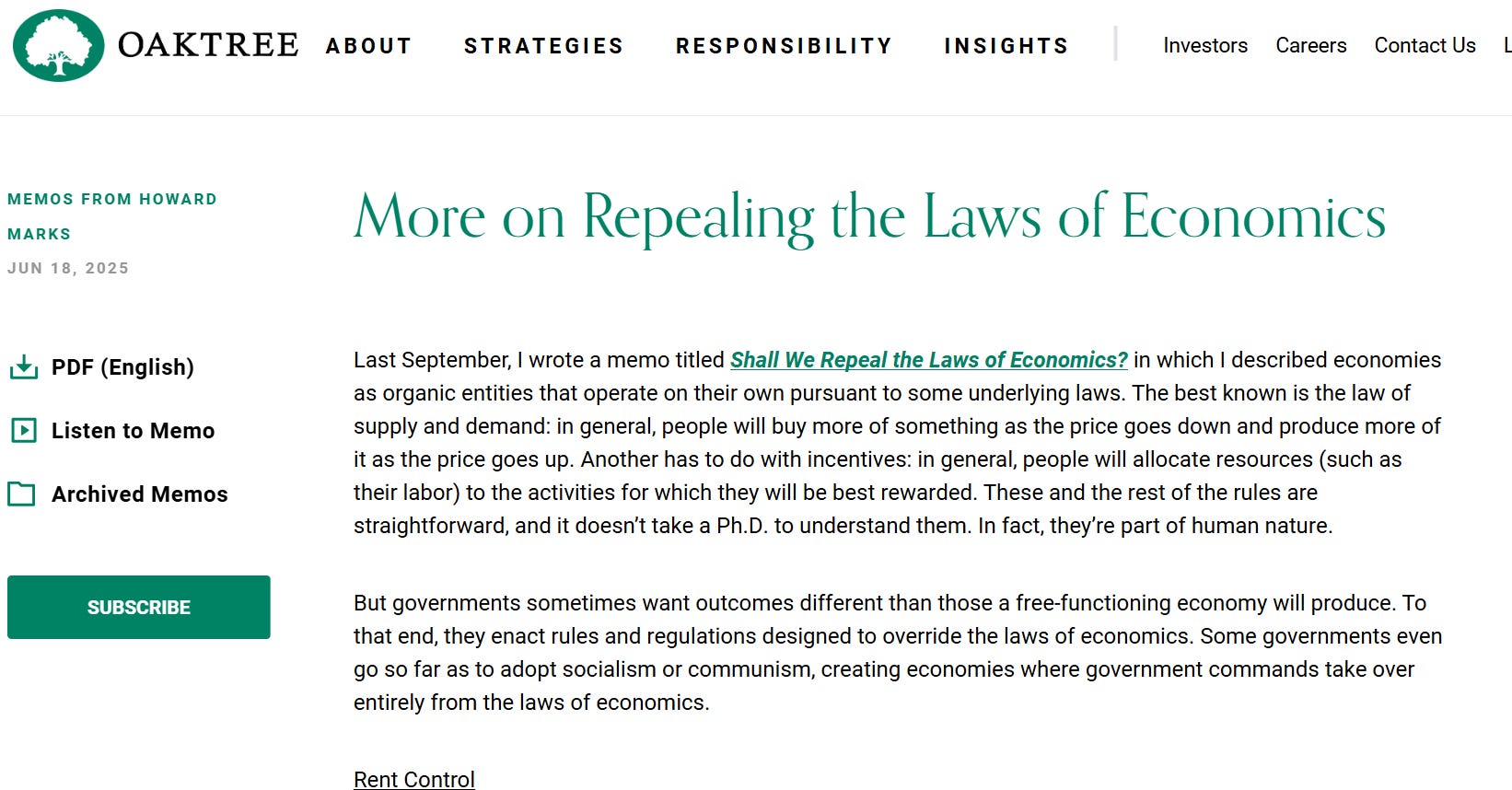
I’ve been a reader/listener of anything I can find by Howard Marks, founder of Oaktree Capital
Warren Buffett says that a memo written by Marks is ‘the first thing I read when I see it on my desk’
Marks’ memos are deep breath of fresh air compared to a lot of the financial media you see on You-tube/TV - his writing is clear, and not full of un-necessary ‘fluff’
This memo essentially details the pros and cons of governments interfering in a free-market system
Marks uses the example of Rent controls to make his point
If a government decides to put a cap on rents (Rent freeze), then landlords cannot by law increase their rent beyond that set point.
The result of this is: happy existing tenants, unhappy landlords
Unhappy landlords = They may decide to not invest any more capital in that area, or they may even take that property off market, hence reducing housing supply. Reduced housing supply = unhappy people who can’t find an apartment
His main argument is that ‘there are no solutions, only trade offs’ - you cannot make everyone happy. Governments assume that one action will have no further unintended consequence.
He then transitions to Tariffs to make the same point.
The essence of this memo is Marks’ appreciation for thinking beyond first-level consequences and the value of the free-market in optimising outcomes for most people
Thank you for taking the time to read this weeks Index!
DF
All information presented above is the opinion of the host/guests on podcasts discussed. This newsletter, nor the podcasts linked above should be taken as investment advice.